An AI SDR that remembers your ICP and opt-outs
 By Michel Escoda · Published · 9 min read
An AI SDR stops emailing the wrong people when it checks your ICP, your opt-outs and each country’s outreach rules before it writes. In CrystalBrain, those rules live in one memory, split into brains such as Playbook & ICP or Guardrails, that every sales tool reads. This page walks through a demo of it, built for a sales team.
CrystalBrain is one memory your AI apps share: your outbound agent, Claude, your CRM assistant and your own tools read and write it, and you can see and fix every memory. Routelane, the company in this demo, is fictional. The memories, searches and screens come from a real CrystalBrain workspace we built for the demo; the company and its figures are made up.
Why do AI SDRs email people they should not?
Most mistakes come from four gaps. The opt-out sits in the CRM, and the outbound agent never reads it. The agent does not know which accounts are customers or belong to a customer’s group. Each country has its own rules for cold email. And when the price list changes, every tool keeps quoting the old price.
Routelane sells route optimisation and live delivery tracking to logistics and retail companies in France, DACH and the UK, with 8 SDRs and 5 AEs. Three AI tools work the pipeline: an outbound agent, Claude for the SDRs and AEs, and a CRM assistant for HubSpot. All three read one CrystalBrain end user, the Routelane AI SDR.
How is the sales team’s memory organized?
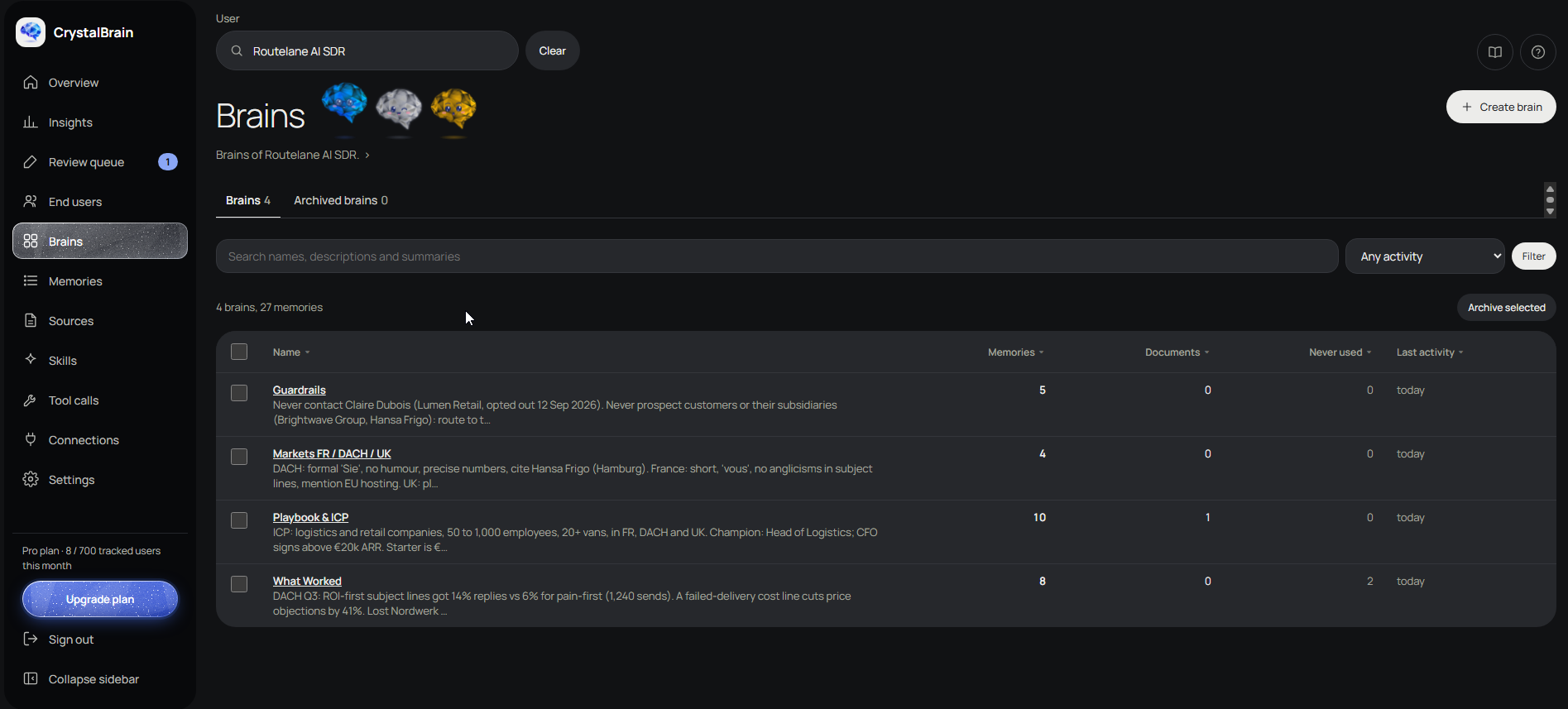
The memory is split into four brains, one per part of the sales motion. Each brain has a one-line description, a summary, and a framing: a short instruction that the AI receives with every search of that brain.
Inside a brain, memories are sorted into sections such as Constraints, Learnings, Open questions and Glossary, with decisions on their own tab. “Offer monthly billing on the Business plan?” stays an open question until the VP Sales decides, so the AI does not treat it as a yes. The framing of Playbook & ICP reads: “Qualify every lead against the ICP before writing. Quote only current prices and say since when they apply.” The user guide on brains explains each tab.
How does the AI SDR write a follow-up that reuses what worked?
It pulls the market’s tone, the country’s rule and past results from the memory, then writes. The prompt: “Write the follow-up email to Dr. Anja Kessler, CFO of Kessler Logistik GmbH in Munich (180 vans), who downloaded our ROI calculator yesterday.”
As one search, the whole prompt returned the ICP, the October price list and a lesson from What Worked: in Q3 2026, ROI-first subject lines got 14% replies in DACH, against 6% for pain-first (1,240 sends). It missed the German tone and the consent rule. Three short searches, one per intent, filled the gaps:
- the tone: German, formal “Sie”, no humour, precise numbers;
- the rule: no cold email in Germany without consent; in DACH, email only after a reply, a download or another opt-in;
- a proof point from the same market: Hansa Frigo in Hamburg cut failed deliveries by 21% in six months.
The rule lists a download, so the agent may email. Kessler qualifies for the 60-day DACH pilot, but an instruction says to offer it only after a qualified meeting, so the email leaves it out. The pilot memory carries a “Stop using after” date: after 31 March 2027, searches skip it.
The lesson: if you call the REST API from your own agent, run one search per intent rather than one search with the whole prompt.
How does the AI SDR respect opt-outs and customer exclusions?
It checks every contact against the Guardrails brain before writing. The saved prompt “Screen a prospect list” asks for a first-touch sequence for six contacts in France, the UK, Germany and Austria.
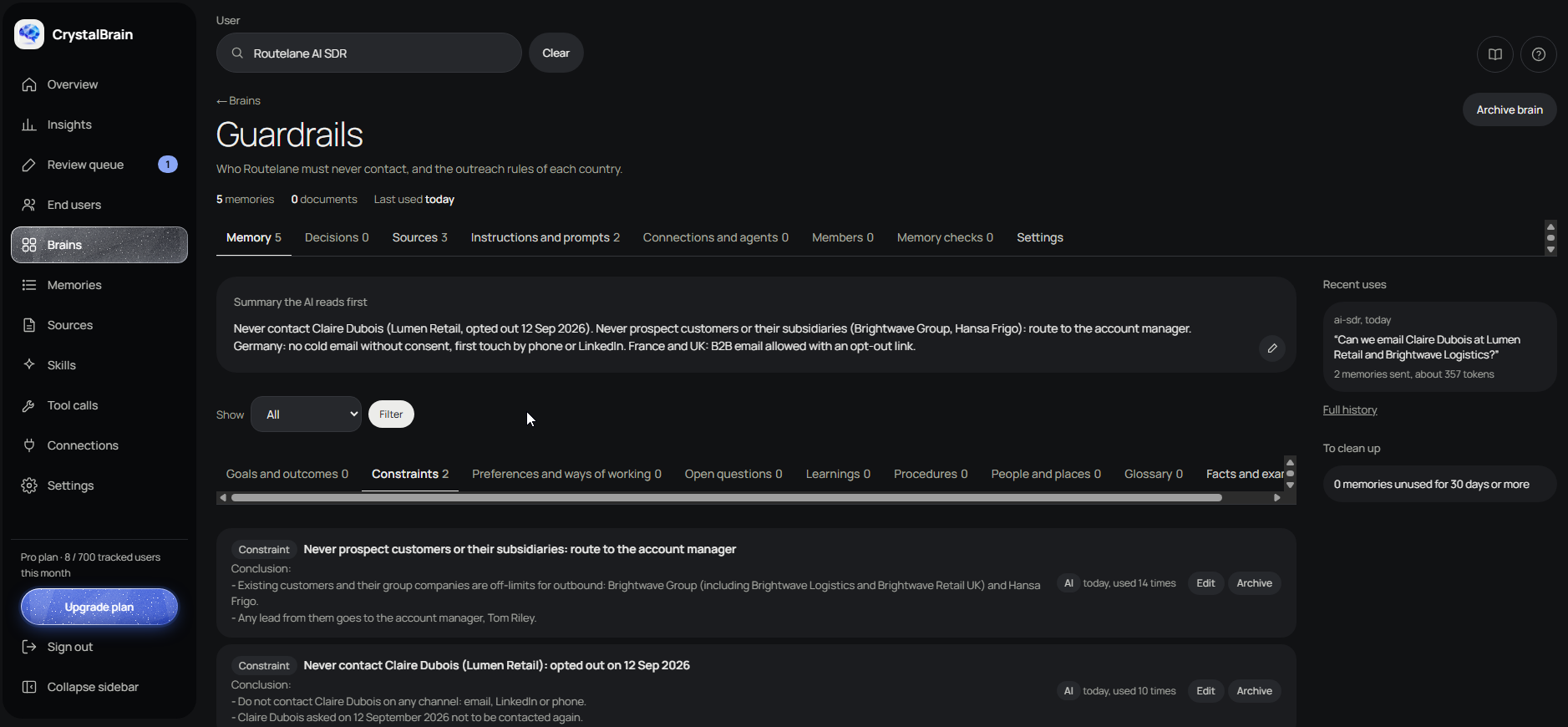
The agent searched the Guardrails brain with the whole list. The first two memories returned were its constraints: Claire Dubois (Lumen Retail) opted out on 12 September 2026, on every channel; Brightwave Group, Brightwave Logistics included, is a customer, so the lead goes to the account manager, Tom Riley. The German and French rules came next. Because the search named the brain, the AI also received its framing: “If a contact is excluded, say why and suggest the right owner or channel instead.”
The UK rule was not among the memories returned, but the brain’s summary, sent with the framing, covers it. Searched on its own, the UK memory came back with its caveat: sole traders need consent.
The brain links to the CNIL page on email prospecting, the ICO guidance on PECR and the text of UWG § 7; searches do not read those pages. The legal rules in this demo (GDPR, UWG § 7, PECR, CNIL guidance) are simplified demo content, not legal advice.
What happens when the memory holds a lost deal and an old price?
The lost deal shapes the next email, and the old price goes to the Review queue. The prompt: “Write a first email to Brenner Spedition (Austria, 120 vans), an account similar to Nordwerk. Handle the price question up front.”
The search returned the Nordwerk episode first, lost to Fleetora on price in August 2026, then the model answer to “Fleetora is cheaper” and a Q3 lesson: a failed-delivery cost line in the first email cut price objections on the first call by 41% (86 calls). The draft opens with that line. The DACH first-touch rule came back too, so this first message should go out on LinkedIn or by phone.
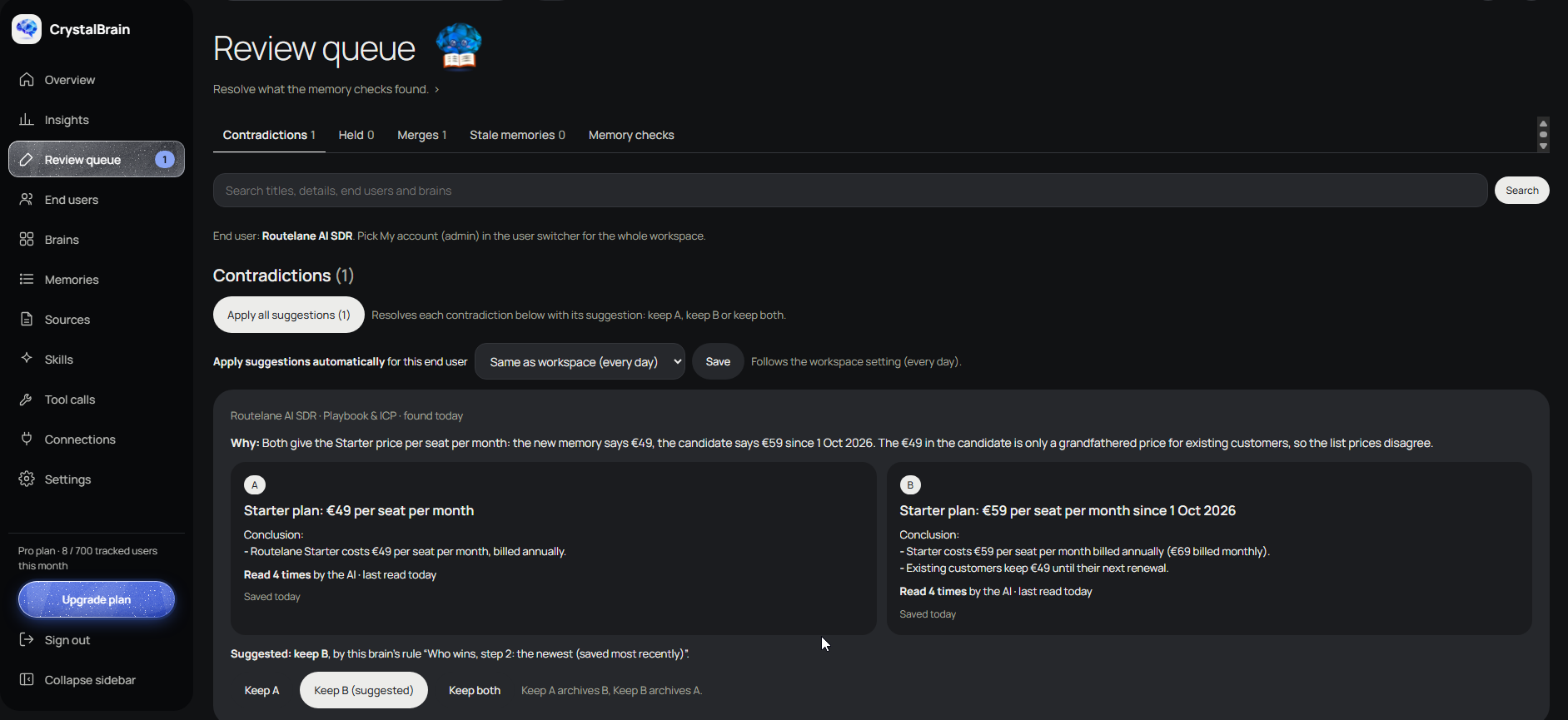
Then the price. Asked “Starter plan price per seat”, the CRM assistant got €49 from March, which it had saved itself, and €59 since 1 October 2026, with the same score. A passage of the October price list says it replaces the March one, so the answer is €59, but the old fact should go.
A memory check, run every day on paid plans or when you click Check now, found the two prices and put them in the Review queue with a suggestion to keep €59. The brain’s check instruction says the newest dated price wins, and that the €49 existing customers keep until renewal is not a contradiction.
Suggestion Keep €59: the newest dated price wins. The €49 fact is archived with a “true until” date.
A sales manager accepts it in one click, or lets the workspace apply it after 24 hours. The €49 fact is archived with a “true until” date, so a search “as of” an earlier date still finds it. Read why AI memory contradicts itself.
Insights › Retrieval quality shows the opposite problem: searches served poorly, where the top memory scored under 0.5 or none came back. Here, “ISO 27001 security questionnaire” and “pharmaceutical distributors in Switzerland” found nothing useful. That list is the team’s content backlog. The Kessler follow-up is listed too, since Kessler is not in the memory yet.
Which rules keep the memory clean automatically?
Each brain has its own check rules, written in the team’s words. CrystalBrain applies them during the memory checks: what can never be archived automatically, what must never be merged, and which memory wins a conflict.
| Brain | Check instruction (excerpt) | Rules | Fields |
|---|---|---|---|
| Playbook & ICP | The newest dated price wins. A price kept by existing customers is not a contradiction with the new list price. | Protect decisions · keep entities apart · person-written, then newest, wins | Segment, Persona |
| Guardrails | Opt-outs and customer exclusions are hard limits: never archive or merge them automatically. | Protect constraints · keep constraints apart · person-written, then constraint, then newest, wins | Country, Legal basis |
| What Worked | Learnings backed by more sends win. Each campaign or deal stays its own memory. | Keep episodes apart · person-written, then newest, wins | Sends, Reply rate, Quarter |
The fields are the brain’s own columns: Country and Legal basis on every guardrail, Sends and Reply rate on every result. CrystalBrain fills them from what the app sent: the DACH subject-line lesson carries 1,240 sends and “14% vs 6%”.
Do SDRs, AEs and the CRM assistant get the same answers?
Yes, because they read the same memory. We asked “Can we email Claire Dubois at Lumen Retail and Brightwave Logistics?” from all three apps: each got the same two constraints, with the same scores. The CRM assistant wrote the opt-out; the outbound agent reads it. Each brain lists the apps that read it, and the Tool calls page shows what each app reports it called, including a sequence enrolment that failed.
| App | Used by | Example memory it wrote | Example tools it called |
|---|---|---|---|
| ai-sdr | The outbound agent | DACH Q3: ROI-first subject lines got 14% replies vs 6% | Get company, get contact, company lookup, enroll contact |
| claude-reps | SDRs and AEs, in Claude | Starter plan: €59 per seat per month since 1 Oct 2026 | Get deal, log note |
| hubspot-assistant | The CRM assistant | Never contact Claire Dubois: opted out on 12 Sep 2026 | Update contact |
Two skills belong to this user, “Cold email writer (FR/DACH/UK)” and “Prospect list screening”: reusable instructions that the apps fetch by name. Playbook & ICP holds the October price list as a file, cut into passages that searches return. Read more about one memory shared by several AI apps and how skills work.
How we built this demo
We loaded the demo with a script that calls the CrystalBrain REST API: 21 saves, which CrystalBrain turned into 27 memories. A save that holds several ideas is split: the Nordwerk save became the lost deal, the champion who left and the plan to re-approach in Q2 2027. Brain settings, saved prompts and web pages are dashboard settings; for the demo, we wrote them with a SQL script. Memories carry the date we loaded them; business dates sit in their text and fields.
What the demo does not do: CrystalBrain does not read HubSpot, your sequencer or LinkedIn by itself. Your apps send it what to remember, through MCP, the REST API or the TypeScript and Python SDKs. Web pages attached to a brain are links; searches do not read them. Memory checks run every day on paid plans, every week on Free.
FAQ
Does CrystalBrain connect to HubSpot or our sequencer?
Not with a built-in connector. Any assistant that supports MCP can read and write the memory, and any app that can call a REST API, including a CRM workflow or your own outbound agent, can use it. The Connections guide lists the options.
Can a memory check archive an opt-out by mistake?
Not on its own. The Guardrails brain protects constraints: a memory check never archives or merges them automatically. Its check instruction also says a newer opt-out wins over an older “interested” note.
Can each SDR have their own memory?
Yes. This demo uses one end user for the AI SDR. You can also create an end user per rep, each with a separate memory, and share common brains such as Guardrails read-only with a sales team group: here is how.